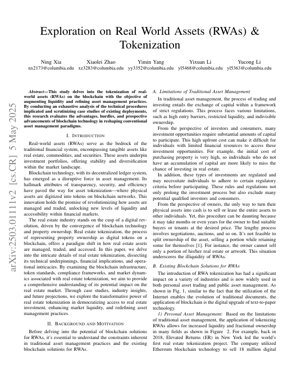
Exploration on Real World Assets (RWAs) & Tokenization: Technical Analysis and Market Impact
A comprehensive analysis of blockchain-based tokenization of Real World Assets (RWAs), covering technical procedures, case studies, advantages, challenges, and future prospects for asset management.
Home »
Documentation »
Exploration on Real World Assets (RWAs) & Tokenization: Technical Analysis and Market Impact
1. Introduction
Real-world assets (RWAs) form the foundation of the traditional financial system, encompassing tangible assets like real estate, commodities, and securities. Blockchain technology, with its decentralized ledger, presents a disruptive force for asset management. Its core attributes—transparency, security, and efficiency—enable asset tokenization, the process of digitizing physical assets into tokens on a blockchain. This innovation promises to revolutionize asset management and trading by unlocking new levels of liquidity and accessibility, particularly in markets like real estate which stand on the cusp of a digital transformation.
2. Background and Motivation
Understanding the current landscape is crucial to appreciating the potential of blockchain solutions for RWAs.
2.1 Limitations of Traditional Asset Management
Traditional asset management is constrained by several key factors:
High Entry Barriers: Significant capital is required for investments like real estate, excluding smaller investors.
Restricted Liquidity: Selling physical assets (e.g., property, art) is a slow, complex process with limited buyer pools.
Indivisible Ownership: Assets cannot be easily fractionalized, forcing all-or-nothing sales and limiting investment flexibility.
Opaque and Inefficient Processes: Transactions involve lengthy negotiations, paperwork, and intermediaries, increasing cost and time.
2.2 Existing Blockchain Solutions for RWAs
Blockchain acts as a digital upgrade layer for asset representation, similar to how the internet evolved document handling. Tokenization is being applied in two broad areas:
Personal Asset Management: Enables fractional ownership and increased liquidity for high-value personal assets like art or collectibles.
Public Asset Management & Investment: Platforms are emerging to tokenize commercial real estate, infrastructure projects, and funds, opening them to a broader investor base.
Key Insight
Tokenization fundamentally rearchitects asset ownership from a monolithic, physical model to a modular, digital one, decoupling value from physical form and custody.
3. Technical Framework for RWA Tokenization
3.1 Blockchain Infrastructure & Token Standards
Successful tokenization relies on a robust technical stack:
Blockchain Choice: Ethereum (with its mature ecosystem), Solana (for high throughput), and dedicated enterprise chains (like Hyperledger Fabric) are common choices, balancing decentralization, security, and compliance needs.
Token Standards: ERC-20 (fungible tokens for shares), ERC-721 (non-fungible tokens for unique assets), and ERC-1400/3643 (security tokens with built-in compliance) are critical standards that define token behavior and interoperability.
Oracles: Services like Chainlink are essential to feed real-world data (e.g., property valuations, rental income) onto the blockchain reliably.
3.2 The Tokenization Process
The process typically involves: 1) Asset valuation and legal structuring, 2) Creation of a Special Purpose Vehicle (SPV) to hold the asset, 3) Issuance of digital tokens representing ownership in the SPV on a blockchain, 4) Distribution and secondary trading of tokens on compliant exchanges.
3.3 Compliance and Regulatory Frameworks
This is the most critical hurdle. Tokenized RWAs, especially those representing securities, must comply with local regulations (e.g., SEC regulations in the US, MiCA in the EU). Solutions involve embedding regulatory rules directly into the token's smart contract (via standards like ERC-3643) to restrict transfers to whitelisted, KYC/AML-verified addresses.
4. Case Studies and Market Applications
4.1 Real Estate Tokenization
The prime use case. Projects have tokenized portions of commercial buildings, residential complexes, and even hotels. Benefits include:
Democratized Access: Allows investment with smaller amounts of capital.
Enhanced Liquidity: Potential for 24/7 trading on secondary markets.
Operational Efficiency: Automated distribution of rental income or dividends via smart contracts.
Example: A $20M office building can be tokenized into 20 million tokens at $1 each, enabling micro-investments.
4.2 Other Asset Classes: Art, Commodities, Securities
The model extends to fine art (fractionalizing a Picasso), commodities (tokenizing gold bars in a vault), and private equity/venture capital funds, increasing market efficiency and access.
24/7 Global Markets: Increases potential liquidity.
Transparency & Auditability: Immutable record of ownership and transactions.
Automation: Reduces administrative costs through smart contracts.
5.2 Major Hurdles: Regulation, Scalability, Adoption
Regulatory Uncertainty: The largest barrier; evolving and fragmented global landscape.
Technological Complexity & Integration: Bridging legacy financial systems with blockchain.
Market Adoption & Liquidity: Requires critical mass of issuers and investors.
Legal Enforceability: Ensuring on-chain ownership is recognized off-chain.
6. Technical Details and Mathematical Models
Valuation and risk models adapt to tokenized structures. A key concept is the Net Asset Value (NAV) per token, calculated as:
$\text{NAV per Token} = \frac{\text{Total Asset Value} - \text{Liabilities}}{\text{Total Number of Tokens Outstanding}}$
Smart contracts can automate this calculation using oracle-fed data. Furthermore, pricing models for secondary trading may incorporate liquidity premiums/discounts, modeled as a function of trading volume ($V$) and token holder concentration ($H$): $\text{Liquidity Adjustment} = f(V, H)$. The transparency of on-chain data allows for more precise modeling of these factors compared to traditional opaque markets.
7. Analysis Framework: Example Case
Case: Assessing a Tokenized Commercial Real Estate (CRE) Offering.
Asset & Structure Due Diligence: Evaluate the underlying property (location, tenant quality, lease terms). Scrutinize the legal structure (SPV, jurisdiction) and custody solution for the physical asset.
Token Mechanics Analysis: Review the smart contract code (audit report), token standard (e.g., ERC-1400), embedded compliance features (transfer restrictions, investor accreditation checks).
Market & Liquidity Assessment: Analyze the platform's trading history, depth of order books, and redemption mechanisms (how to convert tokens back to fiat).
Regulatory Compliance Check: Verify the offering's status with relevant regulators (e.g., SEC Regulation D exemption, EU prospectus requirements).
Financial Modeling: Project cash flows (rent), calculate NAV/token, and model returns under various market scenarios, factoring in platform fees.
This framework moves beyond "the asset is on a blockchain" to a holistic analysis of legal, technical, and financial viability.
Dynamic, Data-Driven Tokens: Tokens whose properties or yields adjust automatically based on IoT sensor data (e.g., a tokenized green bond whose coupon is tied to verified carbon reduction).
Integration with DeFi: Using tokenized RWAs as collateral for borrowing/lending in decentralized finance protocols, creating new yield sources and credit markets.
Central Bank Digital Currency (CBDC) Integration: Direct settlement of tokenized RWA trades in digital currency, streamlining the entire transaction chain.
AI-Powered Valuation Oracles: Advanced AI models providing real-time, consensus-based valuations for complex or illiquid RWAs.
The endgame is a fully digitized, programmable, and interconnected global asset market.
Core Insight: RWA tokenization isn't just a tech experiment; it's a fundamental re-intermediation play. It doesn't remove intermediaries but replaces inefficient, opaque legacy ones (brokers, transfer agents) with transparent, automated, and programmable software layers (smart contracts, decentralized exchanges). The real value isn't in putting a building "on-chain," but in creating a new financial primitive that is natively digital, composable, and globally accessible.
Logical Flow: The paper correctly identifies the pain points of illiquidity and high barriers. Its logic—that blockchain's transparency and programmability can solve these—is sound. However, it underweights the monumental challenge of legal digitization. The tech can represent ownership, but only regulators and courts can legitimize it. The flow should be: Regulatory Clarity -> Legal Structuring -> Technical Implementation -> Market Adoption. We're often trying to run the last three steps without the first.
Strengths & Flaws: Strengths: Excellent framing of the problem. Good high-level overview of the technical components. Recognizes real estate as the killer app. Critical Flaws: 1) Surface-level on compliance: Mentioning "compliance frameworks" isn't enough. The devil is in the jurisdictional details—a token compliant in Switzerland may be an unregistered security in the U.S. 2) Over-indexing on liquidity promise: Secondary liquidity for tokenized assets is still largely theoretical. Creating tokens doesn't magically create buyers; it requires deep, regulated market infrastructure that's still being built. 3) Lack of critical tech depth: It glosses over oracle reliability (a single point of failure) and the scalability/cost issues of running complex compliance logic on-chain.
Actionable Insights: For Investors: Focus on platforms with robust legal opinions and clear redemption mechanisms. Prioritize projects in jurisdictions with advanced digital asset laws (e.g., Switzerland, Singapore). Treat "liquidity" promises with skepticism until proven by live trading volume. For Builders: Don't build technology in search of a problem. Partner with traditional asset originators (fund managers, real estate developers) from day one. Design for regulatory compliance first, not as an add-on. Consider hybrid models where the blockchain records ownership and dividends, but a traditional entity handles dispute resolution and physical asset control in the interim. Macro View: The trajectory is inevitable, but the timeline is elongated. This will be a decade-long rewiring of global finance, not a big bang. The winners will be those who master the trifecta of law, finance, and technology.
10. References
Ning Xia, Xiaolei Zhao, Yimin Yang, Yixuan Li, Yucong Li. (2024). Exploration on Real World Assets (RWAs) & Tokenization. Columbia University.
World Economic Forum. (2023). Blockchain and Digital Assets for Real Estate. WEF White Paper.
Bank for International Settlements (BIS). (2022). Blueprint for the future monetary system: improving the old, enabling the new. BIS Annual Economic Report.
Zetzsche, D. A., Buckley, R. P., Arner, D. W., & Föhr, L. (2020). The Distributed Liability of Distributed Ledgers: Legal Risks of Blockchain. University of Illinois Law Review.
Buterin, V. (2014). A Next-Generation Smart Contract and Decentralized Application Platform. Ethereum White Paper.
Securities and Exchange Commission (SEC). (2017). Report of Investigation Pursuant to Section 21(a) of the Securities Exchange Act of 1934: The DAO. Release No. 81207.
European Parliament. (2023). Markets in Crypto-Assets Regulation (MiCA). Regulation (EU) 2023/1114.